Session 25: Bones and Better Judgement

The echoes of battle had barely faded when the party took stock of the crypt.
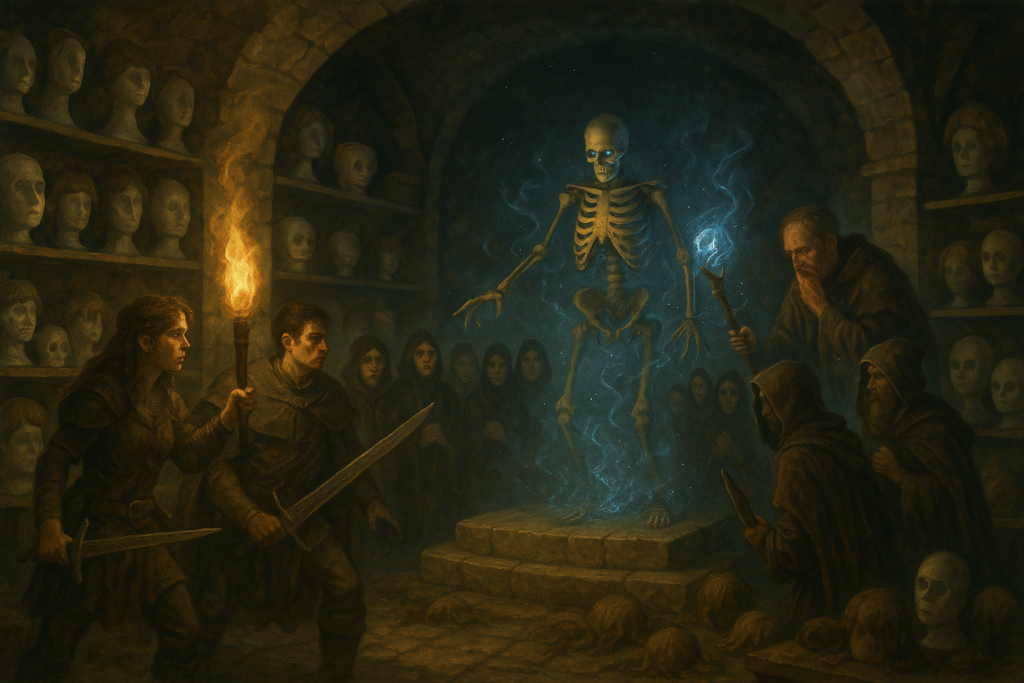
Broken skeletons lay strewn across the floor, their magic spent. Among them were the bodies of four students—collateral damage from a lesson that should never have been taught this way. The instructor responsible still lived, standing amid the ruin with a face caught between horror and disbelief.
What followed was not a fight, but something far messier.
The party pressed him for answers. Why raise the dead at all? Why risk lives for forbidden knowledge? The instructor defended himself with the language of scholarship—experimentation, understanding, prevention. Necromancy, he argued, could not be opposed unless it was first studied. This ritual, he insisted, had gone wrong. The scale of the animation had been unintended. A single target had become many.
Some found his reasoning hollow. Others, uncomfortably familiar.
The discussion quickly became less about what he had done, and more about what should be done now.
Turning him over to the City Watch was an option. So was reporting him to the Emerald Enclave. Letting him go—on his word alone—felt dangerously naïve. Money was mentioned. Morality was questioned. Tensions flared, especially when the idea of profit threatened to outweigh the cost paid by the dead.
In the end, the party chose restraint.
The instructor offered himself up if they wished to report him—but also promised that if spared, he would abandon the practice entirely. The group accepted that promise, uneasily, agreeing to check back on him later. It was not forgiveness. It was not justice. It was a choice made in the moment, with imperfect information and no clean answers.
With dawn still far off and no authority ready to take custody of the man, the party turned its attention elsewhere.
Another problem demanded action.
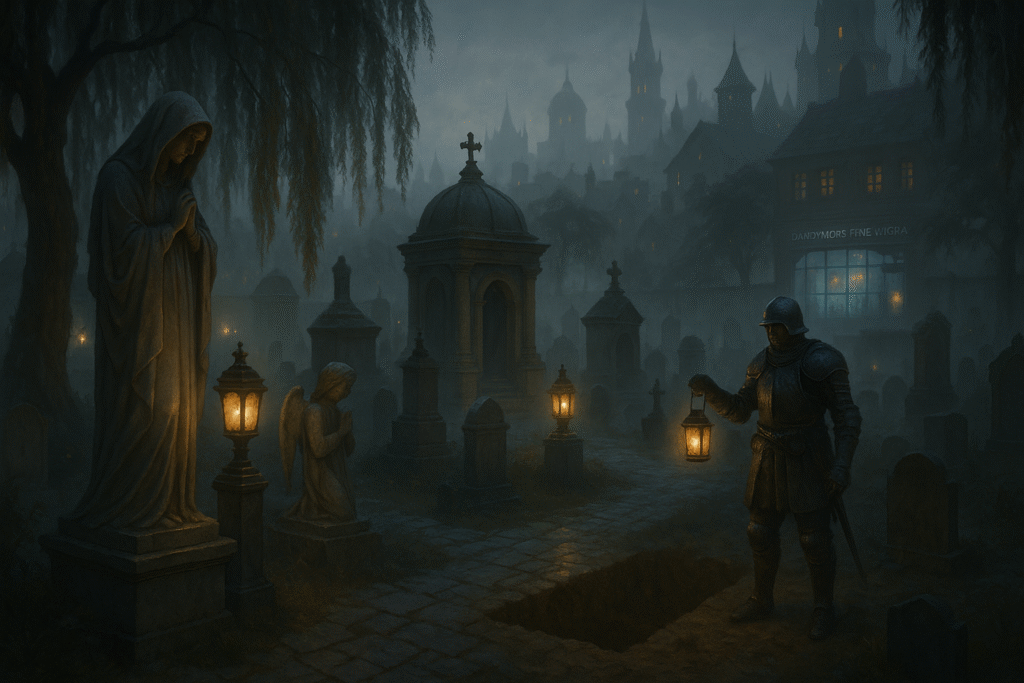
Leaving the crypt behind, they passed through Waterdeep’s sleeping streets and out the city gates, heading into Undercliff. Stone gave way to soil. Lantern light to starlight. The city’s certainty faded behind them as open fields stretched ahead.
As they traveled, they debated routes, recalled past encounters, and set a cautious marching order. Raven and another party member took the lead, eyes scanning tall grass and distant hills. The night felt heavy—quiet in the way that warned something was watching back.
Then it appeared.
A shape on a rise ahead. Half-seen. Never fully standing. Straw hat silhouetted against the dark.
A scarecrow.
The party slowed, aware now that the next fight would not come with explanations or apologies.
And the fields waited.
DM Diary Companion
Knowledge, Consequences, and Choosing Anyway
This session lived in the aftermath.
Combat had already done its work before we sat down, which made the opening moments quieter—and heavier. The visual of destroyed skeletons alongside dead students immediately reframed the table’s energy. This wasn’t a victory scene. It was a reckoning.
The instructor NPC did a lot of work here. He wasn’t cartoonishly evil. He wasn’t innocent. He was defensive, ashamed, articulate, and dangerous in a very believable way. His arguments mirrored real-world justifications: we must study it to stop it, progress requires risk, this was an anomaly. Watching the players engage with those ideas—push back, hesitate, agree in parts—was one of the strongest roleplay moments of the arc so far.
What mattered most wasn’t the “correct” outcome, but that the party had to own the decision.
I deliberately avoided giving them a clean resolution. Turning him in was viable. Letting him go was viable. Neither felt good. That discomfort was the point. Raven’s response—calling out the creeping influence of money and convenience—was especially effective in grounding the scene morally without forcing the group’s hand.
Letting the instructor walk, under promise, sets up future tension without locking the campaign onto rails. It also reinforces a theme that’s been quietly building: Waterdeep doesn’t always reward doing the right thing, and sometimes the best choice still leaves a bad taste.
The transition to Undercliff was intentionally long and procedural. Leaving the city at night, navigating roads, choosing paths, establishing marching order—these moments reset pacing and let the group breathe while quietly rebuilding tension. By the time the scarecrow silhouette appeared, everyone was already leaning forward.
Ending the session on a visual instead of a roll was a conscious choice. The scarecrow didn’t attack. It didn’t move much. It simply was. That image does more work than initiative ever could.
This session didn’t advance the plot aggressively—but it deepened the campaign’s spine. The party made a hard call, learned something about each other, and walked into danger carrying the weight of what they left unresolved behind them.
That’s Dragon Heist at its best.
Session 24:
Related Posts
Session 24: A Class in Catastrophe
Session 23: Masks, Mercy and the Monster