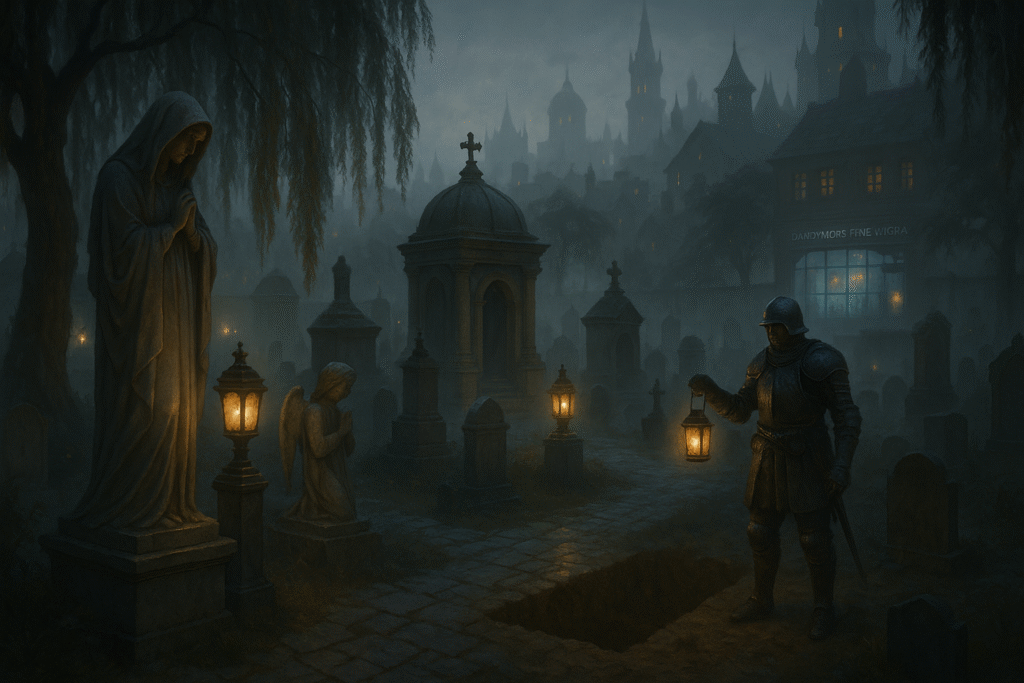
Session 23: Masks, Mercy and the Monster
“‘So, this is how they’ll remember us… as monsters.’ That line hit harder than any attack roll.”
Beneath the sagging floorboards of Dandymop’s Fine Wigs & Powder, the air turned cold enough to steal a breath. The shopfront above, once gaudy and powdered with vanity, gave way to something older—halls shaped by secrets, by echoes, by the soft crumble of dust disturbed only by the cautious footsteps of five adventurers studying the darkness ahead.
The descent was clumsy at times. A porcelain wig-stand skull became a makeshift game of catch. Glass crunched beneath boots despite whispered warnings. But even through the missteps, the party moved together with the kind of instinct forged only by shared danger. And danger, it seemed, was eager to greet them.
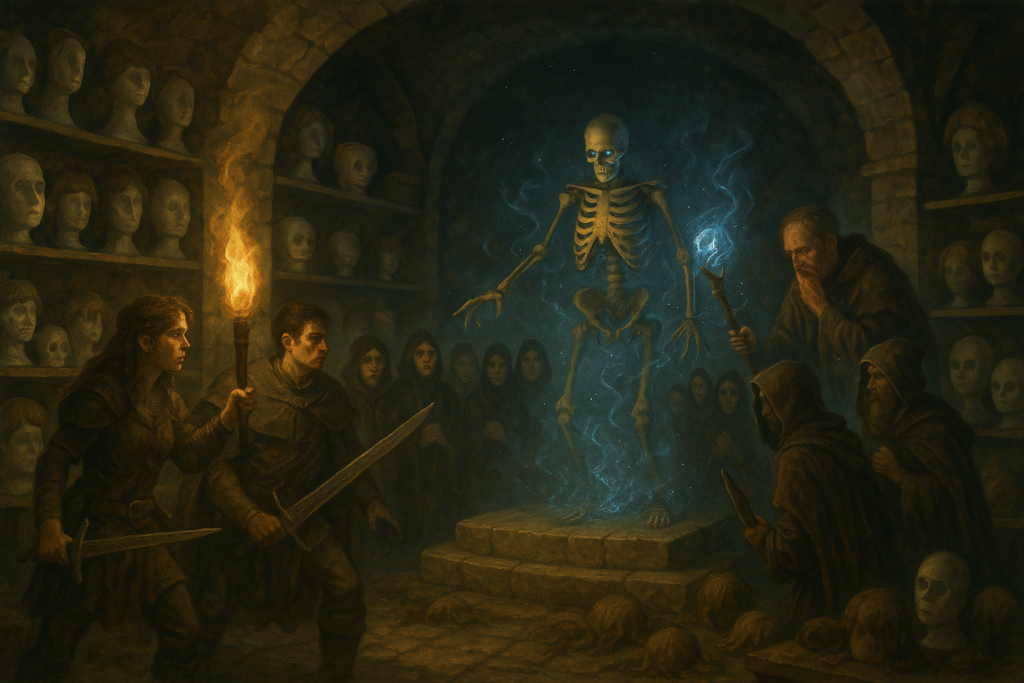
Deep below the haberdashery, the group stumbled into a scene none of them expected: a necromancy classroom. Not cultists, not grave-thieves — students. Nervous, scholarly apprentices standing beside their robed mentor, each of them bracing for judgment from strangers who carried steel and suspicion in equal measure.
Their teacher, an older man with eyes more tired than cruel, asked the question that set the tone for everything that followed:
“Do you come as accusers… or scholars?”
What unfolded wasn’t a confrontation, but a conversation — one thick with tension, doubt, and the uneasy realization that not all necromancy drips with malice. The instructor spoke of discipline, of unchained spells, of undead raised not as puppets but as… possibilities. The party listened, wary but not hostile. For a moment, the dungeon felt less like a battlefield and more like a fragile bridge between two worlds that rarely bother to understand each other.
Then the skeleton stood up.
Light flashed behind its eyes. Bone scraped stone. And whatever lesson the students intended to demonstrate shattered into panic.
The teacher looked upon the creature with something like heartbreak.
“So this is how they’ll remember us,” he whispered. “As monsters.”
Mage Armor flared around him. Students scrambled for cover.
And the adventurers did what adventurers do: stepped between danger and those who could no longer control it.
The battle was immediate and vicious. Flames licked out from the creature’s scepter. Doc took the brunt of a punishing strike and answered with the fury only a raging barbarian can muster. Clover’s quick thinking, Kiril’s practiced positioning, Raven’s eldritch precision, and Maple’s steady resolve all snapped into motion. But the skeleton was no shambling servant — it fought with grim purpose, as though clinging to a memory no spell could erase.
A swirl of magic from Clover’s mysterious deck erupted across the chamber, sending students and skeleton alike scrambling to resist its pull. The creature’s bone-white form began to peel under the assault, cracking and splintering… yet refusing to fall.
And that’s where we left things:
Steel drawn. Spells fading. Students trembling.
A single undead figure standing in the center of a room meant for learning, not war.
The fight pauses mid-breath, mid-swing, mid-spell — waiting for the next session to decide whether the day ends with clarity… or catastrophe.
DM Diary: Necromancy, Nuance, and the Art of Letting the Table Breathe
Every now and then you prep a session expecting it to go one way, only for the players to march themselves—boots squeaking, stealth rolls wobbling—straight into something better than you planned. Session 23 was one of those nights.
This was intended to be the continuation of the descent begun in Session 22, but it also became a litmus test for how my table handles moral ambiguity. And honestly? They surprised me.
Setting the Tone: From Haberdashery to Something Heavier
The approach through Dandymop’s Fine Wigs & Powder worked exactly as I hoped. There’s something inherently unsettling about banal spaces hiding dark truths, and the party’s mix of playful banter and creeping uncertainty did a lot of the tone-setting work for me. They were joking about porcelain wig-stand skulls one moment, and holding their breath while navigating broken stairwells the next.
The 2024 ruleset leans into “fiction-first” adjudication, and here it really helped. Instead of forcing tension, I let the environment breathe—dripping water, broken glass, narrow corridors—and the kids picked up on it without needing to be guided. Even Clover’s scraped boot (lowest stealth roll of the night) played naturally into the atmosphere.
The Necromancy Classroom: A Test of Judgment
This encounter was a deliberate contrast to the bombast of the scarecrows in Undercliff and the emotional intensity of the Urchin/Lif storyline back at Trollskull Manor. I wanted something morally gray, something that asked the players to think rather than swing.
And they leaned in beautifully.
They didn’t arrive with accusations. They didn’t default to violence. They actually listened to the instructor—an ethical necromancer who is teaching students to animate the dead without subjugating them. That was the moment I felt the campaign widen a bit. This group, especially the younger players, typically enjoys momentum and action, but here they showed patience and curiosity.
It also quietly reinforces a core Alexandrian Remix theme: Waterdeep is full of hidden factions, and not all of them are what they appear. A necromancy class in a forgotten basement might look sinister, but even that has layers.
When the Skeleton Rose
Letting the skeleton rise out of control, rather than at the teacher’s command, hit exactly the uneasy note I wanted. It wasn’t a jump scare; it was a tragedy unfolding in real time. The teacher’s line—“So this is how they’ll remember us… as monsters”—landed with the table in a way I didn’t fully expect. It reframed the combat as something that shouldn’t have happened, and for a group learning to care about NPCs, that’s gold.
From a pacing perspective, this was also where I let the tension pivot from social to kinetic. I gave them a full minute of “free positioning” before initiative not as a concession, but as a cinematic pause. The monster rose. Everyone stared. And then adrenaline took over.
Combat: The Joyful Mess Beneath the Story
Two rounds—that’s as far as we got before time ran out—but those two rounds were dense. Doc’s rage softened incoming hits in a way that made him feel heroic without overshadowing the others. Clover’s deck effect was a glorious wildcard, and Raven and Maple each carved out small tactical moments of their own.
A few mechanical notes for myself:
- The students backing away added stakes without becoming liabilities.
- The flame-scepter multiattack had just enough bite for the level range.
- Fear/paralysis effects were impactful, but not punishing—ideal for this table.
- The skeleton’s peeling flesh gave a visceral cue of progress, helping younger players track pacing without needing exact numbers.
Most importantly: nobody rushed for a killing blow. Even in combat, there was hesitation—an unspoken “are we doing the right thing?” I’ll want to reinforce that tension when we resume.
Stopping Mid-Encounter
We ended right on the edge, with the skeleton damaged but still standing. Combat pauses can sometimes deflate momentum, but in this case it’s a blessing. The table will return with fresh nerves, the scene still sharp in their memory, and a cliffhanger ready to be picked up with a bang.
When we resume, I want the fight to resolve quickly—1 to 2 rounds max—so the emotional payoff can return to the real heart of this encounter:
What happens after the dust settles?
How will the students view the party?
How will the party view them?
There’s potential here for alliance, guilt, fear, or even a protective instinct from Kiril and Maple in particular. I’ll let the players steer that ship, but the groundwork is there.
Looking Ahead
This session continues the tonal blend I’ve been building:
- Supernatural mystery (the Lif/Urchin haunting arc)
- Slice-of-life Waterdeep realism (guild inspections, politics, downtime)
- Grounded horror and moral ambiguity (today’s necromancy scene)
It’s a cocktail that seems to resonate with both the kids and adults at the table. And as we edge closer to Ches 7, the Zhentarim split and the fireball tragedy are waiting on the horizon. These moral grays will matter later.
For now, though, I’m proud of this session.
Not because of combat or challenge rating or even pacing, but because the players showed empathy in a story that could have easily turned into a simple fight. They looked at necromancy and saw people instead of monsters.
That’s a win.
Session 24:
Related Posts

Session 25: Bones and Better Judgement
Session 24: A Class in Catastrophe